
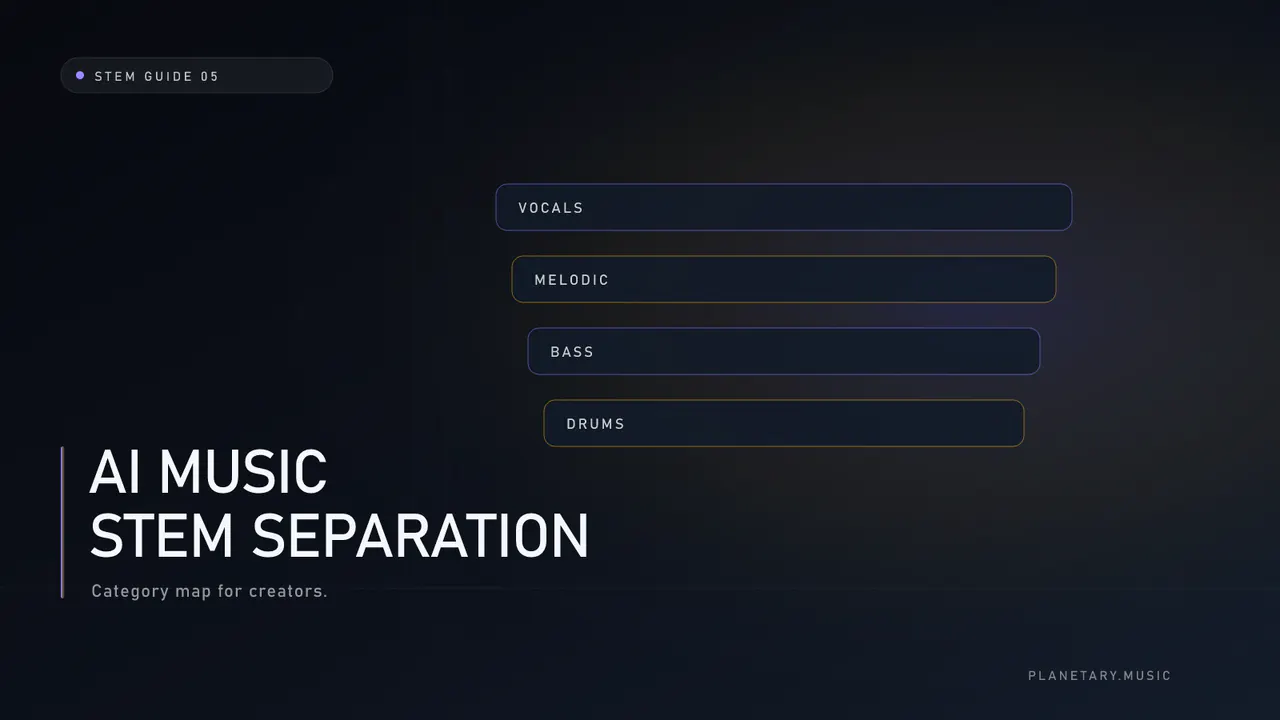
AI music stem separation is the category of tools that estimate individual sources from a mixed recording using machine learning. For AI-generated songs, it unlocks edits a single stereo export cannot support—without claiming perfect multitrack recovery.
Depth should match the next creative decision, not a habit of “max everything.”
Last reviewed: July 22, 2026
Category map
| Layer | Typical stems | Role |
|---|---|---|
| Voice / music | vocals, instrumental | most common edit entry point |
| Music open | bass, melodic, drums | remix and balance |
| Drum open | kick, snare, toms, hats, cymbals | kit surgery |
Two-stem detail: vocal and instrumental separation. Tool behavior: AI stem splitter.
Why definitions matter
People search “separator,” “stem split,” and “karaoke AI” interchangeably. Clear terms prevent broken workflows:
| Term | Means |
|---|---|
| Separation | Estimate sources into files |
| Reduction | Reduce synthetic signatures in a source |
| Mastering | Full-chain finish of a stereo program |
Mixing those jobs produces classic failure modes—like mastering a metallic export and expecting stems to fix it later. Symptom encyclopedia: Suno AI artifacts.
Choosing depth
- Two stems — practice, lyric fixes, simple instrumentals
- Five stems — remix and arrangement balance
- Ten stems — drum detail only when you will use it
Process: how to split AI music into stems. Platform notes: Suno stem split.
Limits that should sit next to every claim
- Bleed and ambience remain.
- Instrumental overlaps component stems.
- Deeper tiers can invent watery texture.
- Rights and platform terms still apply.
- Successful jobs can still sound wrong if the source is damaged.
QC habits that scale with depth
- Solo each stem full length
- Mono check on bass-heavy files
- Matched A/B to the original stereo
- Stop escalating depth when residual artifacts dominate musical gain
How models fail in recognizable ways
| Failure | What you hear | Practical response |
|---|---|---|
| Vocal under-separation | Music still under the voice | Dual-model path or accept bleed |
| Over-suppression | Watery midrange holes | Prefer milder split; keep original |
| Drum smear | Soft attacks after 10-stem open | Stop at bus drums if kit is unusable |
| Low mono collapse | Bass disappears on phone | Check mono before publishing |
| Invented texture | New fizz not in the mix | Reject that tier; use shallower depth |
These patterns show up across tools. Blame the source mix first, the cascade second.
Cleanup and mastering around the category
Harsh texture → reduction (AI audio artifact reduction, tools such as suno-vocal-cleaner service)
Need parts → separation (stem splitter or offline tools)
Final stereo ready → mastering (AI song mastering)
Bridge articles: stem split before mastering, clean AI vocals before mastering.
Frequently asked questions
Is AI music stem separation only for Suno?
No. Any stereo AI or conventional mix can be separated; quality is gated by the source.
Does deeper always sound better?
No. Deeper tiers often reveal more artifacts.
Where should I start today?
Two stems, full QC, escalate only if a named part is required.